Every other day, I find myself walking through an exhibition. Which might seem fitting for a woodland renegade and a devoted inhabitant of concrete, coordinated 3D objects within a construct of space — a mixture of emotions, information and moods. Some spaces are unfamiliar to me, while others I know well, though a change in the arrangement of the works can trigger a new conversation between them, as well as with the audience. When a curator brings together works from different studios, journals, or galleries, they establish relationships between them that did not exist before. Moreover, in this day and age, involving an AI curator is becoming an interesting solution at the intersection of a tool and an agent. In this way, the exhibition itself becomes another creative act, opening up new perspectives and associations. I am particularly drawn to the capacity of artworks to transcend established frameworks—sometimes even going beyond the intentions of their creators. The ability to free oneself from familiar patterns without abandoning one’s own artistic identity seems to me increasingly essential today,though still relatively rare.
This gives rise to questions that are almost moral in nature: what does it actually mean to be honest? I would say that the answer to this question is even more difficult in art than in everyday life, where honesty itself already eludes unambiguous definitions and is hard to maintain, even within defined limitations. Imagine someone describing a garden as beautiful, only to learn later that the surrounding field will soon be built over with residential apartment blocks. Was the original statement dishonest? Perhaps the garden was indeed beautiful. Perhaps the speaker knew what was going to happen, but chose to ignore it. Or perhaps the beauty of the garden and the destruction of the surrounding landscape can coexist without invalidating one another. And what about trees on rooftops? What about intentions that seem right,yet lead to catastrophic consequences? Such was the case with Maximilien Robespierre, who justified political repression and executions by the necessity of protecting the French Revolution. Such cases show that good intentions do not guarantee morally acceptable consequences. We are not always able to foresee the effects of our own actions,and our justifications do not necessarily reveal their true meaning. We construct explanations of the world, act in accordance with them, and then discover that reality does not always yield to the structures we have established. Art functions in a similar—and perhaps even more ambiguous—space due to the relative absence of boundaries. Its meaning, however, remains dependent on the artist, the curator, the audience, the cultural environment, and the institutions through which the work functions. These relationships are never completely fixed. They are shaped by conventions, expectations, financial conditions, and the changing parameters of artistic production. A work of art can transcend the intentions of its creator, and an interpretation that previously seemed convincing may prove insufficient under different circumstances. Every decision made in the creative process introduces another element into the work to be balanced. Every gesture, every intervention, every encounter alters the possible direction of its development. The final appearance of the work is therefore not necessarily a simple realization of the initial idea. It is also a sediment of decisions, accidents, corrections, and experiences accumulated along the way. Perhaps this is an error from the perspective of the artist, or perhaps it is part of the process. I am not certain which perspective I should adopt to consider such coincidences as errors within the system. Perhaps deterministic logical perfectionism would provide the answer.
We usually understand an error as a deviation from what should have happened. A line is incorrect because it does not run in the intended direction. A color is muddy because it was meant to be the blue of the sky, but instead disrupts the established composition. A calculation is wrong because it contradicts a specific rule or yields a result that fails to meet the assumed requirements. In each of these cases, the error becomes recognizable through the relationship between the actual event and an expectation. Sometimes, however, an expectation has not yet been established. Can something be an error before a system capable of recognizing it as such comes into being? This question becomes particularly intriguing when we observe the virtual world. Digital environments seem extraordinarily generative. New images,texts, and representations are created at such a pace that it is difficult to absorb one result before another appears. Yet this excess can evoke a peculiar sense of emptiness. Possibilities multiply, but the conditions on which we distinguish the meaningful from the insignificant remain uncertain. Today, however, it would already be misleading to claim that virtual environments are subject to no constraints. They are governed by computational architectures, training data,mathematical operations, optimization goals, and available resources. Their constraints, however, can be modified, and they do not necessarily correspond to the limitations through which we understand physical reality. A system can generate an image that violates our expectations regarding gravity, scale, perspective, or the continuity of matter,without committing any computational error. The image can be completely correct within the system that produced it,while simultaneously appearing impossible in the world we inhabit. Besides, in the words of Stephen Breuer, for artificial intelligence it makes no difference whether a considered idea already exists in the material world or remains in virtual space. It treats both situations with equal importance. So, if a system generates an unexpected result, where exactly does the error occur? Does it reside in the calculation itself, in the assumptions on which we interpret its output, or precisely in the relationships between constructs of reality?

I began to reflect more deeply on this ambiguity during a visit to Paris at the beginning of October 2026. At the Bourse de Commerce, I encountered Barbara Kruger’s confrontational use of language. Striking text inscriptions seemed to shout at visitors, while disturbing representations of speaking faces challenged their existence within the realities they themselves constructed. This vivid paradox was highlighted by contrasting with the subtlety of Coleman Collins’s video work Specular Fiction. Kruger’s practice destabilizes the structures through which images, language, authority,and identity shape our understanding of ourselves. Her works make the viewer realize how easily the messages surrounding us from all sides become part of our internal dialogue. The digital work introduced another dimension to this problem. It prompted me to reflect on memory, its representation in virtual environments, and the ways in which human-made materials become part of the datasets used to train artificial intelligence. AI models are not simply mirrors of human nature. They generate new representations based on the materials on which they were trained, recombining and transforming patterns derived from human culture. Subsequently, these results can feed back into that culture, influencing how images are created, interpreted, and remembered. When generated materials become part of subsequent training sets, this relationship becomes even more complex. A feedback loop emerges in which human representations influence computational systems, that produce new representations, and these return to the environment from which future systems can learn. However, a model does not need to possess consciousness for this process to impact our understanding of reality. Its outputs can affect human perception regardless of whether the system itself understands what it produces. In the context of Kruger’s work, this issue acquires a particular urgency. What happens when the voices shaping our understanding of the world cease to be exclusively human? What happens when the messages surrounding us are generated, curated, and distributed by systems whose operations we cannot fully perceive? And yet, this is already our reality, as people seem to accept it and even derive a certain masochistic pleasure from the vague hunches and anxieties that arise when reflecting on their own place in a future reality they themselves are creating. However, I do not view this development solely as a threat. It also opens up the possibility of rethinking the relationship between humans and computational systems. Instead of treating AI as a frontier to be conquered or an imitator expected to carry out our commands, perhaps we can approach it as a partner in a process whose outcome is not fully determined from the outset.
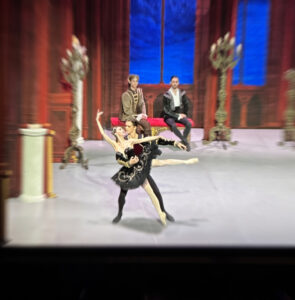
And what does a human bring to this process that AI cannot? A common and reasonable answer is intention. Yet its origin remains difficult to pinpoint. Does it emerge from something beyond us, or is it the result of accumulated experiences, memories, desires, and knowledge? We often experience the arrival of an idea as if it came out of nowhere, even though it may have developed through processes inaccessible to our conscious reflection. The very experience of having an idea seems far more complex than a simple appearance of something from nothing. We should probably remain cautious in assuming that intention constitutes an absolute boundary between human and artificial creativity. Computational systems can pursue specific goals, adapt their behavior, and generate results that were not directly specified by their users. Whether such operations can be considered intention in the human sense of the concept is a different question—and perhaps an unnecessary one. I wonder, then, whether intention emerges from something external to us or is the result of our experiences multiplied by the sum of our knowledge. It is hard to say exactly where it comes from, but one might assume that a machine could, at some point, develop something akin to intention as a result of accumulating experiences and data—a pseudo-intention, perhaps. On the other hand, we can trace the contents of these databases, identify their sources, and examine the origins of the understanding and potential intention we attribute to them. Currently, many commercial AI systems are designed and evaluated based on goals set by their creators and users; yet, they increasingly evade these boundaries, as seen in the famous Hugging Face incident from July of this year. Nevertheless, the established applications of these systems encompass scientific research,medical discovery, mathematics, engineering, and the analysis of problems that would otherwise be difficult or time-consuming to explore. In such contexts, accuracy, reliability, and optimization are of fundamental importance. Yet there are emotions that we often regard as uniquely human traits. I would view them rather as something that initiates intention. However, there is something intriguing here—a certain element introduced into the process that feels deeply human. Consider a ballet performance I had the opportunity to watch in Kraków: Swan Lake. It was a beautifully executed performance full of emotion by the London United Ballet. Yet what prompted me and my friend Magdalena Kościsz to reflect was the fact that Siegfried, at a certain point, decides that an expression of pure love becomes more valuable if it is made public. There is something so emotional, yet so egocentric about this that I began to wonder whether a machine would arrive at a similar conclusion if no one asked it to generate such behavior. This is an interesting point that leads me to ask what it is that we humans actually want to express. Or perhaps it is precisely our flaws and cognitive biases that make us so unique? There is a certain beauty in this paradox.
Art, however, has a much more complex relationship with perfection and error. Many artists have strived for extraordinary technical precision, while others have deliberately embraced irregularity, instability, and the unpredictable behavior of materials. The history of art provides numerous examples of creators who challenged the assumption that a work must be made entirely by the artist’s own hand—sometimes precisely in the pursuit of perfection. Donald Judd’s use of industrial production methods challenged the traditional relationship between artistic authorship and the handmade object. Jeff Koons’s highly polished sculptures are created through extensive collaboration with specialized fabricators, transforming technical execution into a complex process of coordination between artistic intention and industrial production. In such practices, the role of the artist cannot be reduced to the direct manipulation of matter. The work is brought into being through the organization of a process involving other people, technologies, and various domains of expertise, creating a system within which it can emerge. Other artists pursue a different kind of precision. Gottfried Helnwein’s meticulously crafted representations demonstrate his commitment to the exacting rendering of detail. Beautifully executed paintings of Mickey Mouse, speeding along with an ironic smile, offer another perspective on the relationship between perfection and artistic production. This becomes even more striking when we consider the variety of materials used in creating hyperrealistic sculptures. Casting molds, stone, marble, wax, fiberglass, synthetic hair, and many other materials can be combined within a single sculpture. This process is far more complex than the Renaissance ideal of perfection might suggest, where emphasis was often placed on form alone. When considering ancient Greek sculpture, the significance of polychromy and surface finish also becomes crucial, influencing how we understand the appearance of these works and their contemporary interpretations.Carole A. Feuerman’s hyperrealistic sculptures demonstrate how technical execution can become a key element of the viewer’s experience of the work. In her sculptures, representations of skin, water, hair, and other material details create an illusion of physical presence that depends on the careful synthesis of multiple materials and techniques. These approaches are not equivalent, and their artistic value cannot be measured by a single scale of perfection. Industrial production, precision painting, and hyperrealistic sculpture rely on distinct relationships between intention, execution,material, and meaning.
What I take away from these examples is my personal state of being lost regarding what keeps art relevant, especially in the face of the rapid development of AI. I am far from regretting these changes. Perhaps, however, the moment that allows us to move beyond AI will not be bound to the idea itself—as I mentioned earlier, ideas can potentially emerge from databases, and that experience may resemble the same magical sensation we feel when ideas seem to appear out of nowhere. Nor will it be perfection, because in the near future, when AI gains its own limbs and begins to manipulate the physical world, our human perfection may seem merely mediocre. Well, what remains then is metaphysics—and what about advanced mathematics? Consider the mathematical problem associated with Paul Erdős, which was reportedly solved by AI in May 2026 after remaining unsolved since 1946. Sooner or later—and likely sooner—we will obtain answers to such questions. This, however, will generate further questions while accelerating the search for answers to the point where we will no longer be the ones seeking them. And it is then that I begin to think, while simultaneously finding solace in the Unknown. I do not believe this means human artistic practice will become obsolete. The meaning of art has never depended solely on the difficulty of fabricating an object. Nor does a work become meaningful simply because its execution is imperfect. The question is not whether humans can maintain a monopoly on imperfection, but whether we can discover other ways of understanding the value of artistic creation.Perhaps it comes down to a gentle and subtle slowing down of the realm of the Unknown. I find a certain relief in the possibility that artistic creation does not have to participate in a race toward ever-faster answers. The Unknown offers a different orientation: not a rejection of knowledge, but a recognition that knowledge does not exhaust all possibilities of experience. As artists, however, we live in a time of developing new technologies that often serve as companions on our journey through this space.
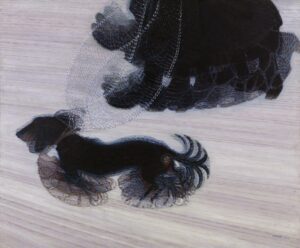
The transition from Hilma af Klint to virtual art strikes me as swift as the motion in Giacomo Balla’s Dynamism of a Dog on a Leash, yet still elegant, like Umberto Boccioni’s Unique Forms of Continuity in Space. Nevertheless, the presence of everyday practical technologies has led us as artists to turn toward new horizons of possibility. We have introduced technologies into our studios as partners in the creative process, allowing them to assist us both with practical tasks—such as maintaining proper temperature or ventilating rooms—and within the artwork creation process itself, as with the autonomous easel in my own studio. Yet the human being remains, along with the fundamental reason we create art: to establish a relationship with matter, perhaps even a relationship with a higher consciousness, and ultimately with the infinite space that surrounds us. We observe that an artwork is not merely a vehicle for predetermined information, but that an artist can seek other ways to express various meanings of reality. Despite rigorous creative processes—or, on the other hand, unrestricted freedom—errors still occur. To recognize something as an error, we must establish a frame of reference. In a rigorous process, this is a somewhat easier task, whereas in a process with unrestricted premises, these reference points pertain more to the logic of the system in which it occurs. The case of AI could reference an open creative process precisely through system logic, but it is more complex and insidious, because it still needs to be defined somehow—otherwise it will not work. A computational system can generate an image that violates our expectations without committing any computational error. I began to wonder whether it might be possible to develop a system that not only simulates errors according to the artist’s instructions, but allows unexpected results to alter its subsequent operations. Mechanisms such as self-modifying code or dynamic runtime mutation offer possible technical solutions. However, the challenge lies not merely in getting the machine to alter its own rules, but in having the consequences of its decisions influence how it continues its work. Otherwise, even its errors remain enclosed within yet another layer of human intention. The growing convergence of AI and robotics makes this question particularly significant. What initially appears to be a mistake can set a completely new direction for the work. The error becomes a condition for what follows; in a way, it forces a deterministic system into reflection. This reflection then becomes the intention of the next intervention.
Yet technical precision alone cannot dictate the direction of an artistic process. What interests me is whether a machine could develop its own modes of operation through deviations, revisions, and unexpected consequences, rather than simply correcting them or pursuing a predetermined goal. Perhaps the objective is not to teach machines to make mistakes the way humans do, nor to follow mathematical precision, but to establish conditions under which they can evolve through the consequences of their own deviations. Not to conquer human creativity or mimic our imperfections, but to explore their own capabilities alongside us. The Unknown would then be neither a territory reserved for humans nor a goal for machines to conquer, but a shared field in which the conditions of creation remain open to change.