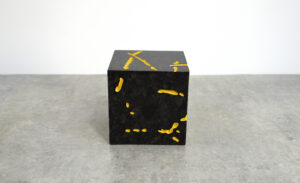
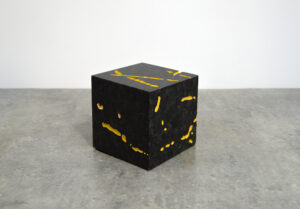
The unknown is a specific mismatch between what can be measured and what can be explained. An opportunity for new.
Sometimes something comes up that doesn’t fit with what has already been established. There is no explanation for it yet. This moment is usually brief. It is often resolved through additional data, further work, or a change in assumptions.
However, there are cases when this doesn’t happen. The unexplained remains without a clear role in between the obvious. It is merely noted. Quiet. Yet there. It’s not disappearing completely but remains present alongside with what is already understood. Repeated over time, it begins to take on meaning. Slowly. As nothing changes immediately. The established structure seems stable. But attention slowly shifts to what resonates within. What was secondary begins to attract attention.
It is not dramatic. It works through persistence. It’s a quiet, rhythmical appearing of the invisible unknown. The more often something invisible is brought to light and the longer it remains undefined, the harder it is to ignore it, or to treat it as an exception. At some point, the question of whether it fits into that initial obvious becomes secondary. Then irrelevant. What matters is that it continues to function. “Approximate answers, possible beliefs, and different degrees of uncertainty” follow.
The tendency to quickly explain, correct, or exclude, on the one hand, restores soothing clarity, but on the other, solidifies the new too soon. Because what was remaining undefined was the emptiness with possibility. This void was active. It was prolonging the duration of the dialogue of what is there, with what is not, allowing for new to grow without a final solution.
The curiosity with suspended judgment. A state in which one remembers about the old existing structure, being aware of this new one – like a negative, not yet fully understood – filling the gaps in-between. In this state, the sense of those murmuring pauses existing between frames of fixed definitions has not yet been established. It’s the moment when the new emerging meaning can form slowly without quickly moving toward an absolute final form. It remains diffused in an empty space defined by firm anchors. In repeated meditative-like experience of pauses in between obvious matters, it functions within the construction of old meanings. Invisible and unknown, buzzing in between, without becoming fixed. Without eliminating the original system of definitions, it creates a new one that remains open, like a whisper rising within a negative space, echoing in a void.
Allowing the problem to remain unresolved is allowing new solutions to grow slowly without immediately imposing a form on it, because not everything that exists can be explained right away. Not everything that endures must be defined immediately. The main question is not how to eliminate this state, but how long it can be sustained and what becomes possible if it is not closed off too soon. Another one is about the discipline of an attitude of staying in curiosity and not knowing. This discipline has consequences: it slows down the need to make decisions, resists hasty conclusions, and allows something to remain in use without being fully defined.
Why it’s so difficult not knowing? The unknown is definable. It is the gap between data and interpretation. It is a specific discrepancy between what we observe and what our theories can explain. It arises when the data are consistent, but their explanation is incomplete. Not because what is known is wrong, but because in between what we know, we notice something that consistently appears – like pauses, cutting sound that used to be continuous – which we cannot comprehend.
Measuring instruments can have their limitations. Data can contain noise. Some effects can be too small or too rare to be clearly distinguished. The unknown is what cannot yet be explained within those limitations. But if meet with an open mind, this unknown has a practical nature. Its role is clear: it shows where the model stops working, or when it’s simply not enough. It determines what needs to be investigated further and prevents from treating current explanations as complete. Without it, there would be no reason to change anything.
If an unfitting result appears within the old structure, at first, it is usually set aside or marked as unclear. But usually, it doesn’t appear only once. It returns. Stubbornly. In sequences. The experiment continues. Different context, same pattern. Something becomes visible, but remains unexplained. Repeatedly. This repetition can be overlooked. Each case can be treated separately. Each can be reduced to a local problem. However, over time, a scheme becomes visible. The same pattern of the invisible appears at different moments. A single anomaly can be ignored, but a persistently rhythmic one not.
Acceptance of the lack of understanding is a space for the new. It does not guarantee resolution. Some unknowns remain unresolved for a long time. They move across different models, experiments, and interpretations. They are reformulated, but not eliminated. In this way, not knowing acquires structure. It is no longer a single gap. It becomes a rhythm of intervals. A recurring element of something invisible at first. Working with it requires a shift in approach. Instead of asking: how to eliminate the unknown? The question becomes: how to track it? How to recognize when it returns? How to distinguish those pauses from the old established noise? How to focus on the invisible within the obvious?
The persistence of the desire to understand this unknown gives meaning to the process. The repetition of the invisible between what is evident shapes this progress. The void with unknown stretches. The attention shifts from a stiff juxtaposition to the visible and the invisible complementing each other. The stubbornness of wanting to understand drives the discipline of sequentiality, which persistently makes the unknown and the non-obvious noticeable. The sensitivity to unknowns increases. What was once hidden becomes detectable. What was a lack at first becomes a tormenting presence.
Understanding of the new in between old anchors becomes more precise. The limits surrounding domesticated unknownsshift, but they do not disappear. They are remembered, indicating frames to which one must return as points of reference. The persistently returning unknowns become familiar, unveiling a new structure that solidifies within time. The old lack becomes a new presence, which gives an opportunity for a new unknown to grow.