(Lat. emergere – to rise up, to come to light) – a process in which a completely new, unpredictable quality arises from the relations of simple, interconnected elements, one that cannot be explained at the level of its individual components.
In the contemporary world – a world that has been through it all – the apogee of this phenomenon occurs at the intersection of human intention and dense networks of language models. Transcending the boundaries of biological or social observation, emergence suggests that seemingly dead matter is capable of generating a living quality. Thereby calling consciousness into question, prompting us to consider who we might eventually be.
Reality
It seems to me that we, humans, stand at the foundation of all definitions, which – by now, almost certainly – are needed only by us. It is through them that w e impart meaning to the world around us and gain the ability to navigate it efficiently. Reality, framed this way, depends entirely on us; we are the ones who decide what to deem significant within our construction of the world. In this reckoning, pragmatism often takes the lead – and rightly so, at least within a linear model of reality. However, such a practice is a natural layering of constructs and beliefs, to which we eventually lose the thread of understanding. This happens due to a simple fact: reality is neither linear nor deterministic. A question then arises: is a given phenomenon, operating within our current construct, not flawed precisely through the lens of the frames in which we enclose it? Frames whose primal origins we can no longer easily trace. A similar thing happened, for instance, with geocentrism.
Emergence
We can observe this specific causality when examining social and cosmic phenomena, as well as other processes based on massive datasets and dy –
namic relations. In contemporary terminology, the word emergence appears – a concept making a comeback today, also as a by product of advanced language models. These models express themselves precisely through datasets with a vast network of relational connections. Art has become a relatively safe space for experimenting with emergence. However, emergent phenomena can be found as far back as the earliest cultures studied by anthropology. Many societies with more flexible structures demonstrated a capacity for adaptation and self-organization without heavily formalized rules. It can therefore be assumed that a smaller number of rigidly enforced constructs favored emergent processes and allowed for safer functioning under conditions of volatility. Back then, life itself, relationships, and growth constituted a more fluctuating field of possibilities – in stark contrast to modern day checking off subsequent benchmarks of progress and setting up further binding definitions. This habit intensifies alongside the expanding baggage of entrenched structures we carry. It is precisely in emergence that I see a remedy for this tendency.
Belief and Error
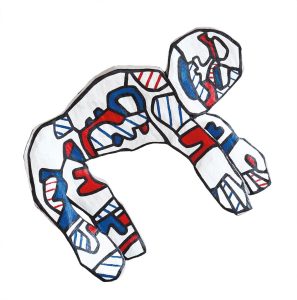
Unfortunately, the phenomenon of emergence often manifests only fleetingly, sparking initial awe, only to be swiftly reduced to a rigid definition, a method, or a tool used to forge antitheses against already entrenched paradigms. In line with a pragmatic view of reality, this approach is also applied within the fine arts – though there, it can feel like an abuse of the concept, yielding counterproductive results. A prime example is Jean Dubuffet. When he reached his most popular creative period – the monumental Hourloupe cycle – his work, originally rooted in an intuitive, free, and emergent gesture, quickly turned into a repetitive method and production tailored to market demand. One could even say the artist fell victim to the Midas syndrome. We can, however, speculate whether, throughout the years of this serial production, truly emergent moments did not surface, only to be dismissed by the rational mind of the creator or the art dealers visiting his studio. Leaving aside the metaphysical value of emergent forces, they possess the power to make us aware of the errors we commit, even when following a logical path of cause and effect. Today, decades after their creation, these market objects give conservators a headache – the synthetics and polyesters used by Dubuffet are deteriorating from within, exposing the instability of a method meant to immortalize success.
If we wish to move past speculation, however, let us look at the facts. In her series Lettres de ma mère, Vera Molnár replaced the plotter with a classic printer – a device designed primarily for text reproduction. This resulted in shifts and distortions of the script. What could have been dismissed as an error or a technical flaw was recognized by the artist as an aesthetic and creative value. This was an incredibly vital moment for contemporary art –akin to the moment Man Ray embraced chance as a fully -fledged medium when creating his famous Cadeau (Gift), the iron with tacks glued to its bottom. The object was born spontaneously on his way to an exhibition, and its immediate disappearance that very evening meant the physical object
ceased to matter – the pure idea survived.
Authorship
The pivotal question, then, is not how to create what is expected and compliant with a temporary construct, but how to engineer a situation in which emergence reveals itself in a beautiful and inspiring way – for both the artist and the viewer? It turns out this can be achieved through the careful, tender multiplication of elements within a system. By deliberately letting go of absolute control, we allow autonomous networks to breathe unpredictability into the structure. In doing so, we align with a cosmological framework, balancing on the fine line between entropy and syntropy. Harold Cohen created the complex AARON sy stem – one of the first programs to generate images autonomously. In doing so, he challenged very concept of authorship. The issue of authorship still feels like unaddressed terrain in our culture; in fact, this state of affairs ofteen leads to diminishing the value of works that are inherently good. Rejecting works created with the aid of artificial intelligence solely because of how they were made seems like a peculiar form of censorship. Following this logic, they should simply be burned, lest they be preserved for future generations and accidentally deemed valuable. Such a outlook brings to mind an almost grotesque image of yet another burning of the Library of Alexandria.
Relations
As early as 1968, art theorist Jack Burnham predicted in his concept of Systems Esthetics that the single artistic object would hold less and less significance in the art of the future. Its place w as to be taken by a system of relations, processes, and information within which the work is created and functions. Joseph Nechv atal, in turn, by introducing the term v iractuality, brought tw o constructs closer together: virtual reality and actual (physical) reality. At the intersection of these two worlds, a system surfaces, and with it – the emergence of the contemporary world and art. This fluid, hybrid space forces us to redefine how forms originate. A completely different, far more reductive approach was represented by Manfred Mohr, who focused exclusively on the constructs themselves and the visualization of retrospectively examined processes. Similarly, Casey Reas absolved himself of the role of a mere executor of rules trapped inside the structure; he viewed the situation from the outside, translating it into an aesthetic experience that became an emergent outcome of the rigid frames of already operating processes.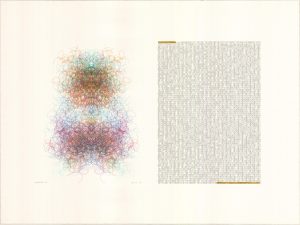
Looking at the beautiful, harmonious arrangement of seemingly meaningless strings of ones and zeros, Roman Verostko invoked the memory of Alan Turing. He referred to the visual representation of this binary notation as a “celebration,” likening digital structures to the ornaments surrounding sacred texts. From my perspective, however, a far more compelling emergent phenomenon arises when the code was written for an entirely different, mundane purpose – such as running a simple calendar program. Yet, these computational frameworks do not exist in a vacuum; they inevitably spill over into the organic realm. These systems of relations are expanded even further by Eduardo Kac, who involves not only humans and technologies in the creative process, but also other bio-organisms and plants.
Destabilization
When a work becomes merely a byproduct of a process, an interesting digression emerges v is-à-v is traditional painting and the classical arts. A question arises regarding the purpose of conserving such objects, as well as our drive to immortalize temporary orders. In this light, the physically
changing, aging works of Dubuffet can evolve in an emergent manner into even more compelling aesthetic phenomena – if only we allow them to. Of particular significance in this context are the compositions created by Anselm Kiefer; they can be understood precisely as processes suspended in time — fleeting configurations of relations, gestures, and structures, wherein peeling concrete, oxidizing lead, and crumbling ash continuously renegotiate the final shape of the work.
The Encounter
In relation to complex neural networks – derived from language, mathematics, and statistical models – this system becomes further complicated. Refik Anadol trains hundreds of models on massive datasets, designing specific conditions in which a new visual experience can manifest. The final image here becomes merely an artifact of a process that can no longer be fully predicted or engineered.
Paradoxically, we often remain deeply attached to our own constructs. We retouch the outputs of algorithms, curate images, and correct results so that they better align with our traditional concepts and aesthetic expectations. Perhaps artificial intelligence is developing as a completely distinct form of potential being, whose internal logic will forever remain distant from human constructions of reality. It is precisely within this contrast that one can attempt to seek a temporary answer to the question of what a human being is.
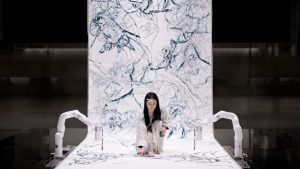
When Sougw en Chung introduces her own gestures into machine learning systems, and a robotic arm co-creates a drawing on canvas with her, emergence not only participates in the creative process but also redefines the status of the human being. The author ceases to be the sole source of decision and form – becoming instead a participant in an intimate relationship with the machine.
In this sense, art utilizing artificial intelligence shifts the existing paradigm
from ready -made (the found object) to mind-made (the product of pure thought process). Stephan Breuer points to this fundamental transition, using the term mind-made precisely in opposition to the limitations that accompanied Marcel Duchampʼs creativ e process. The concept of the ready – made, though revolutionary, was still tethered to the material world – it depended on the act of selecting an already existing, physical object. Breuer reverses this paradigm: through artificial intelligence, our very thinking becomes an autonomous medium, and the material world – merely a secondary outcome of this process. Taking it a conceptual step further, the artist notes that AI is teaching humans something far deeper today : How to prompt reality.
In my understanding, this concept outlined by Breuer implies that mind – made is no longer an act of selecting a physical object, but the engineering of the very conditions of thought, relations, and dynamic structures from which the work is yet to emerge. The machine here is no soulless replicator. After all, as early as 1967, Sol LeWitt wrote in his Paragraphs on Conceptual Art that “The idea becomes a machine that makes art.” Today, in the era of algorithms, this metaphor materializes literally.
Post Sci-f i
Contemporary artists using AI, such as Anna Ridler, are redefining the traditional way of describing images. Much like Anadol, they possess the ability to evoke worlds built on data – data provided, for now, by humans, yet ultimately resulting in creations that often transcend our grasp of reality to a degree so profound that our first impulse shifts between awe and dread. This controversial method of artistic creation is an emergent phenomenon of the very construct of the world cracking before our eyes. The ultimate experience of such works is not a closed state, but one remaining in a constant feedback loop. Networks of relations continuously expand, and with the accelerating speed of information flow, our rigid constructs lose their relevance before w e even manage to fully describe them.
I call the apogee of this state of affairs Post Sci-fi.